

Natural fibers have earned their place in great menswear. Wool can create beautiful structure and drape, linen offers unmistakable summer character, and cotton remains one of the most versatile fibers in a man’s wardrobe.
But does that mean every garment containing polyester is automatically inferior?
Not necessarily.
Understanding natural vs synthetic fabrics requires looking beyond the name printed on the label. Modern textiles can be incredibly sophisticated, and what matters most is understanding why a particular fiber was used.
Natural Fibers Still Have an Important Advantage
There is a reason we frequently recommend natural materials for classic menswear.
Wool, cotton, linen, cashmere, and other natural fibers offer characteristics that are difficult to replicate completely. They can provide beautiful texture, natural breathability, comfortable drape, and a richness that often becomes more interesting as the garment is worn.
For suits, trousers, shirts, and other timeless wardrobe pieces, fabric is part of what gives the garment its character.
That doesn’t mean every 100 percent natural garment is automatically high quality. Construction, fabric quality, fit, and finishing still matter.
Fiber content is one piece of the puzzle, not the entire answer.

Synthetic Fibers Can Serve a Real Purpose
Modern polyester is considerably more sophisticated than many people realize.
Synthetic fibers can be engineered to provide specific characteristics including stretch, durability, wrinkle resistance, moisture management, insulation, water resistance, and faster drying.
For performance clothing, travel garments, outerwear, and other pieces designed around a particular function, those characteristics can be genuinely useful.
This is where understanding natural vs synthetic fabrics becomes important.
Rather than immediately rejecting a garment because it contains polyester or another synthetic material, ask what that fiber is accomplishing. If its inclusion noticeably improves the garment’s intended performance, there may be a legitimate reason for it.
Ask Why the Synthetic Fiber Is There
The bigger concern is when synthetic fibers are used primarily as an inexpensive replacement for a more costly material without adding a meaningful benefit.
Imagine comparing two summer jackets. One uses a carefully considered blend to improve durability or wrinkle resistance. Another contains a large amount of inexpensive synthetic fiber simply to reduce manufacturing costs.
The labels might look similar, but the reasoning behind the fabrics is completely different.
That’s why shopping based entirely on percentages can be misleading.
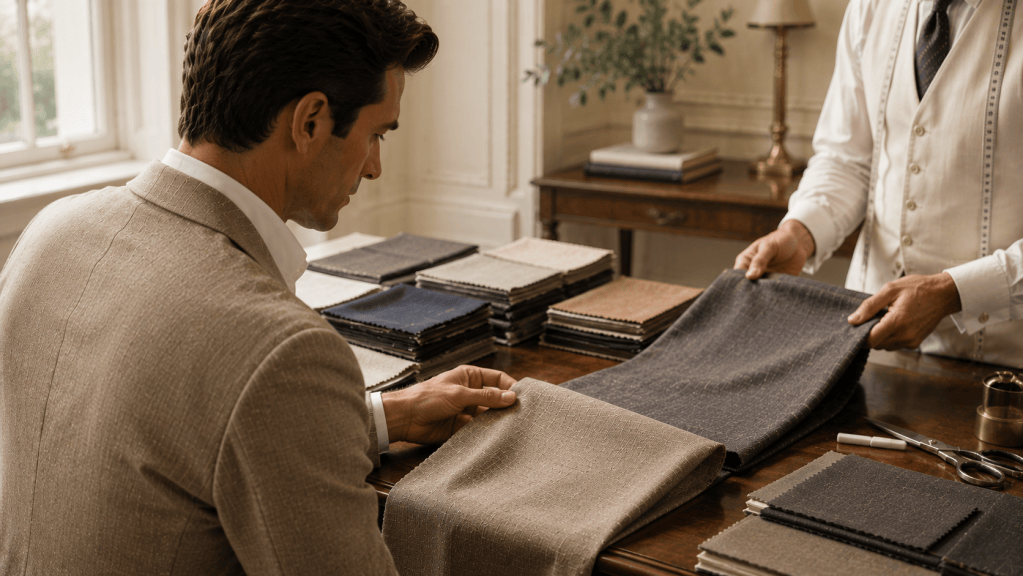
Touch the fabric. Look at how it drapes. Consider what the garment is designed to do. Examine the construction. Think about where and how you’ll actually wear it.
An informed shopper evaluates the garment rather than simply searching the label for one particular word.
Better Clothing Decisions Start with Understanding the Garment
The debate over natural vs synthetic fabrics shouldn’t be reduced to one being good and the other being bad.
For timeless tailoring, we continue to appreciate the beauty, history, texture, and performance of exceptional natural fabrics. But modern synthetics can also be valuable when they’re used deliberately and for the right purpose.
At Albert Gerald Master Tailors, we believe the fabric, construction, proportions, and fit of a garment should work together. A beautiful material alone cannot rescue poor construction or improper fit, just as the presence of a synthetic fiber doesn’t automatically make a garment poor quality.
Read the label, but don’t stop there.
Understanding why a garment was made the way it was will make you a much smarter buyer.
Visit Albert Gerald Master Tailors, in Jersey City, Millburn, or Somerset and discover how the perfect fit can transform even the simplest outfit.
FAQs
Q1: How long do alterations typically take?
We recommend allowing at least 1.5 weeks for alterations to ensure ample time for fittings and adjustments. We can accomodate rush delivery as fast as next day for an additional rush fee.
Q2: Can I bring in a suit or dress purchased elsewhere?
Absolutely! We’re happy to tailor garments purchased from any retailer to fit you perfectly.
Q3: Do you offer consultations for custom designs?
Yes, we provide consultations to discuss your vision and how we can bring it to life through tailoring.
Q4: What should I bring to my fitting appointment?
Bring the shoes and undergarments you plan to wear on your special day to ensure accurate measurements.
Q5: Are there options for last-minute alterations?
While we recommend early planning, we do offer expedited services for last-minute needs, subject to availability.
Q6: How do I schedule an appointment?
You can schedule an appointment by visiting our website or calling our stores directly.